Somewhere on the internet right now, someone is standing in a pharmacy aisle holding two bottles, one labeled azelaic acid, the other tranexamic acid, both promising the same thing: fading dark spots. Both are backed by dermatologists. Both show up in “holy grail” TikTok videos. And both cost roughly the same.
Only one question actually matters: which one clears your specific dark spots faster?
This isn’t a question with a marketing answer. It’s a question with a research answer, and that research exists. Dermatologists and researchers have run head-to-head trials, tracked patients for months using a standardized scoring system, and measured the results in percentages, not vibes.
In this guide, we’re pulling the actual numbers from clinical trials, including a direct 100-patient comparison between the two ingredients, so you can stop guessing and start treating your skin based on evidence. We’ll also build you a routine and point you toward specific, tested products at the end.
The Quick Answer
For melasma (the blotchy, hormone-driven patches on cheeks, forehead, and upper lip), the current evidence leans toward tranexamic acid fading pigment faster and more consistently, especially in combination or oral form.
For post-inflammatory hyperpigmentation from acne (the marks breakouts leave behind) and for pigmentation that comes with redness or active acne, azelaic acid tends to be the smarter first choice because it treats the inflammation causing the marks, not just the pigment itself.
They are not really rivals. They work through different pathways, and research shows combining them often beats using either one alone. Let’s look at why.
What These Two Ingredients Really Are
Azelaic Acid: The Multitasker
Azelaic acid is a naturally occurring, nine-carbon dicarboxylic acid, originally identified in grains like wheat, rye, and barley. It’s been a prescription and over-the-counter ingredient for decades, sold under brand names like Finacea and Azelex, and typically used at 10%, 15%, or 20% concentrations.
How it fades dark spots:
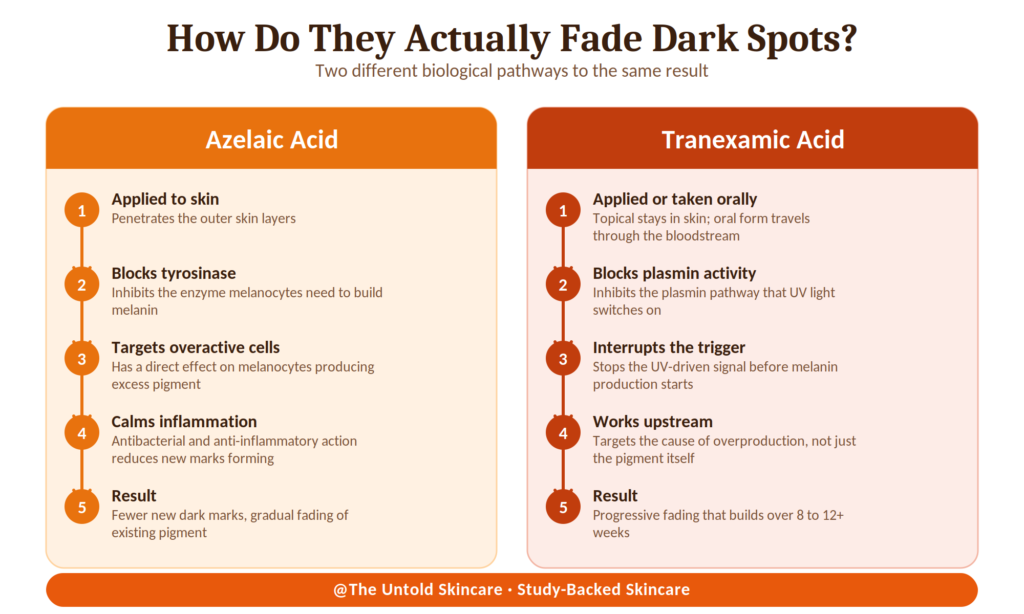
Azelaic acid works mainly by competitively inhibiting an enzyme called tyrosinase, which your skin needs to produce melanin (pigment). Research also shows it has a direct effect on overactive melanocytes, the pigment-producing cells themselves, which may explain why it works especially well on stubborn, uneven pigmentation.
It also has anti-inflammatory and antibacterial properties, which is why it treats acne and rosacea at the same time it treats pigmentation.
Tranexamic Acid: The UV-Pathway Blocker
Tranexamic acid (often shortened to TXA) has a very different origin story. It’s a synthetic derivative of the amino acid lysine, and it was originally developed decades ago as a medication to control bleeding by inhibiting an enzyme system called plasmin. It’s still used in hospitals today for that exact purpose.
How it fades dark spots:
Researchers discovered that tranexamic acid also works as a plasmin inhibitor in skin, and plasmin activity is part of the chain reaction that UV light triggers to produce excess melanin. By blocking this pathway, tranexamic acid interrupts pigment production at a step upstream of melanin creation itself. It’s available topically (usually 2% to 5%), orally by prescription (typically 250 mg, once or twice daily), and even as in-office microinjections.
Also Read: The Simplest and the Only Skincare Routine You’ll Ever Need
The MASI Score: How Scientists Actually Measure “Fading”
Before we get into results, it helps to know how researchers score this. The Melasma Area and Severity Index (MASI) is the standard scale dermatology researchers use in clinical trials. It scores the face on darkness, homogeneity (evenness), and the percentage of area affected, producing a number typically between 0 and 48 (or 0 to 24 per side in the modified version, mMASI).
When you see “a 49% reduction in MASI score,” that means the treatment cut the calculated pigmentation severity nearly in half. This is the number you’ll see throughout this article, so it’s worth understanding it once, clearly, right here.
What the Azelaic Acid Research Actually Shows
A Systematic Review of 20+ Trials
A 2024 systematic review pooled data from multiple randomized controlled trials (RCTs) to evaluate azelaic acid across rosacea, acne, and melasma. The review concluded that topical azelaic acid is more effective than placebo for rosacea, acne, and melasma, based on the available randomized controlled trial evidence.
For melasma specifically, the review pooled 7 separate RCTs. Across these 7 studies, azelaic acid 20% was found to be considerably superior to the vehicle (placebo) for both global improvement and severity, and it also outperformed hydroquinone 2% for global improvement, with minimal differences in adverse events between azelaic acid and comparison treatments.
The Number on Acne-Related Marks
Since so much of the “dark spots” search intent is actually about acne marks, this is worth calling out specifically: across 5 RCTs on acne, azelaic acid 20% reduced comedone counts by a mean of 70%, compared with only 14% for vehicle, and at the 3-month mark, 64% of patients treated with azelaic acid showed “good to excellent” global improvement, compared to 36% of those on vehicle.
The Darker Skin Tone Trial
This matters a lot if you have melanin-rich skin, since that’s exactly where melasma and post-inflammatory marks show up most.
In a randomized, double-blind, multicenter trial of patients with Fitzpatrick skin types IV to VI (medium to deep skin tones) with at least moderate melasma, investigator ratings showed significantly greater improvement in the azelaic-acid-treated group, and chromameter readings, an objective device measurement of pigment intensity, confirmed small but statistically significant decreases in pigment compared to control.
The difference in global improvement between azelaic acid and vehicle was statistically significant by week 24 (P = 0.008), and more patients on azelaic acid reported smoother skin and higher satisfaction, though azelaic acid did cause slightly more burning and stinging than vehicle in the early weeks.
Takeaway:
Azelaic acid’s evidence base is strongest for acne-related dark marks and for melasma in deeper skin tones, and it comes with a real anti-inflammatory bonus most other brightening ingredients don’t offer.
What The Tranexamic Acid Research Actually Shows
The Landmark Oral Study
One of the most cited tranexamic acid trials is a randomized, placebo-controlled, double-blind study specifically on oral tranexamic acid for moderate-to-severe melasma.
At 3 months, patients taking oral tranexamic acid saw a 49% reduction in their mMASI score, compared to only 18% in the placebo group, and patients with severe melasma improved even more than those with moderate melasma. Interestingly, the benefit didn’t disappear immediately after stopping treatment: three months after treatment was stopped, the treatment group still showed a 26% reduction in mMASI score from baseline, compared to 19% in the placebo group.
The Meta-Analysis View (Pooling Everyone’s Data)
A meta-analysis and systematic review of tranexamic acid trials found consistent effects across the pooled data. Pooled data from tranexamic-acid-only observational studies showed a MASI score decrease of 1.60 points on average (95% CI, 1.20 to 2.00; p<0.001) following treatment.
A larger, more recent meta-analysis looked specifically at how fast the effect builds. Across 21 studies covering a combined 1,167 patients using oral, topical, or injected tranexamic acid, the pooled analysis showed statistically significant reductions in MASI/mMASI scores at 4 weeks, 8 weeks, and 12 weeks of treatment, with the effect size continuing to grow through the 12-week mark. This tells us something practically useful: tranexamic acid’s fading effect is progressive, not a quick fix, and results genuinely keep improving for at least 3 months.
Does Strength Matter?
If you’re wondering whether a stronger topical percentage is automatically better, one trial specifically tested this. A double-blind RCT comparing topical 10% tranexamic acid against topical 5% found that the reduction in MASI and pigmentation scores was similar between the two strengths and not statistically significant after 4 and 8 weeks of treatment.
In plain terms: once you’re using a leave-on tranexamic acid product, going higher than 5% doesn’t appear to buy you much extra benefit, but it may add irritation risk.
Takeaway:
Tranexamic acid’s strongest evidence is in oral form, and even topically, its effect compounds over 8 to 12 weeks rather than working quickly. Patience matters here more than concentration.
Related Post: Best Natural Home Remedies for Acne Scars
The Head-to-Head Study: Azelaic Acid vs Tranexamic Acid
Here’s the part most articles skip: an actual trial that put these two ingredients against each other in the same patients over the same timeframe.
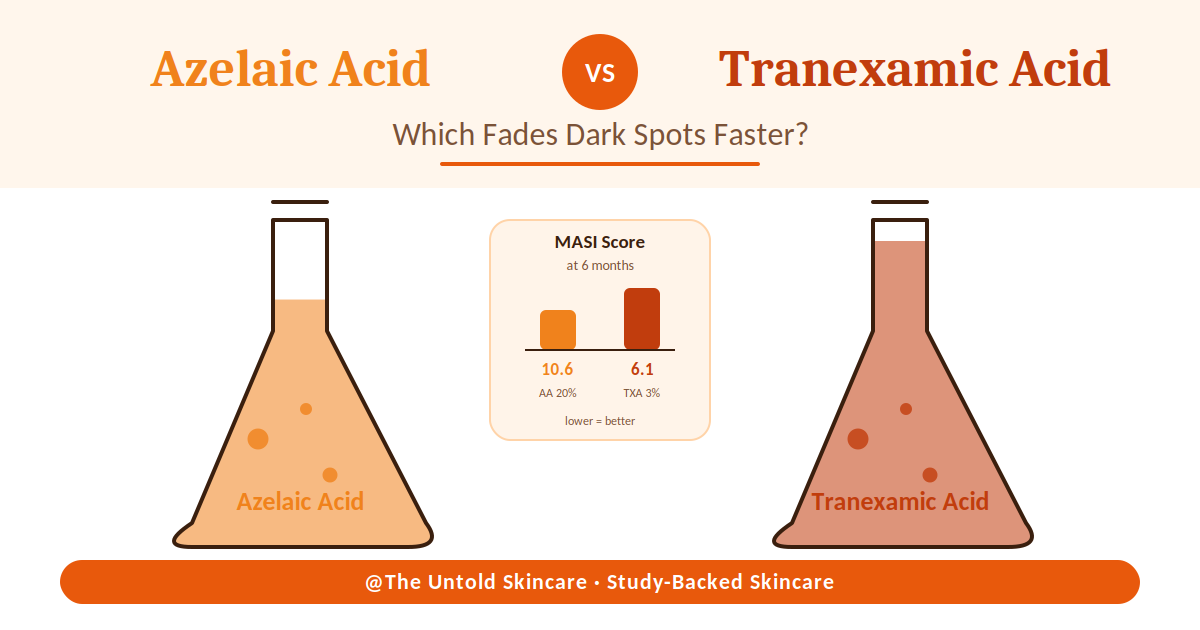
A 2019 study published in the Journal of the College of Physicians and Surgeons Pakistan ran a 6-month interventional comparative trial on 100 melasma patients, split into two groups of 50.
Group A: Oral tranexamic acid (250 mg twice daily) plus topical 3% tranexamic acid solution, applied twice daily.
Group B: Oral tranexamic acid (250 mg twice daily) plus topical 20% azelaic acid, applied once daily at night.
Both groups also used SPF 60+ sunscreen daily, a detail worth remembering for later.
Both groups started at a similar baseline MASI severity (33.7 in Group A versus 34 in Group B), and there was no statistically significant difference between the groups at 2 months (p=0.20) or 4 months (p=0.89) of treatment. But by 6 months, a clear gap opened up: the mean MASI score dropped to 6.06 in Group A (the tranexamic acid combination) versus 10.62 in Group B (the azelaic acid combination), a difference that was statistically significant (p=0.001).
Patient-rated outcomes told a similar, if less dramatic, story: 28% of patients in Group A reported an “excellent” response, compared to 22% in Group B.
The researchers’ conclusion:
The combination of oral and topical 3% tranexamic acid was significantly better than oral tranexamic acid with 20% azelaic acid for treating melasma.
Which One Wins for Which Type of Dark Spot?
Not all “dark spots” are the same condition, and the research suggests the right choice depends on what’s actually causing yours.
| Your Situation | Better First Choice | Why |
| Melasma (hormonal, symmetric, cheeks/forehead/lip) | Tranexamic acid | Strongest RCT and meta-analysis evidence, works upstream of pigment formation |
| Post-inflammatory marks from acne | Azelaic acid | Treats the underlying inflammation and bacteria, not just the pigment |
| Pigmentation with visible redness or rosacea | Azelaic acid | Documented anti-inflammatory and anti-redness effects on top of brightening |
| Deeper skin tones (Fitzpatrick IV to VI) | Azelaic acid | Specifically studied and shown effective in this population |
| Sensitive or reactive skin | Azelaic acid (10% or lower) | Generally better tolerated at lower, OTC strength |
| Melasma that hasn’t responded to topicals | Oral tranexamic acid (prescription) | Strongest single-ingredient trial data (49% MASI reduction at 3 months) |
| You want the fastest visible change | Neither, realistically | Both take 8 to 12+ weeks to show meaningful, measurable change |
Also Read: How to Reduce Sebum Production? A Comprehensive Guide
Side Effects and Safety: What the Data Says
Azelaic acid is generally considered one of the gentler actives, but it isn’t side-effect-free. In the darker-skin-tones trial, azelaic acid produced significantly more burning and stinging than vehicle, particularly in the first 4 to 12 weeks, though most patients still rated it well-tolerated overall. It’s considered safe during pregnancy, which is a major advantage since melasma frequently appears or worsens during pregnancy.
Tranexamic acid has a different safety conversation depending on the route. Topical and even most oral studies report it as well tolerated, with the JCPSP head-to-head trial noting no major side effects in either arm.
However, oral tranexamic acid works by affecting clotting, so it is not recommended for people with a personal or family history of blood clots, stroke, or certain clotting disorders, and it isn’t recommended during pregnancy. This is exactly why oral tranexamic acid is prescription-only and needs a doctor’s sign-off, while topical tranexamic acid, which doesn’t meaningfully enter the bloodstream, is available over the counter.
One universal finding across every single study cited above: every trial that mentioned sunscreen use required it, and several studies note that treatment effects are undermined without consistent sun protection. Neither of these ingredients works if UV exposure keeps re-triggering pigment production.
Can You Use Them Together?
Yes, and there’s a good mechanistic reason to. Since azelaic acid mainly blocks tyrosinase and kills overactive melanocytes, while tranexamic acid blocks the plasmin pathway triggered by UV exposure, they interrupt pigment production at two completely different points. Using them together is not redundant, it’s complementary.
A practical way to combine them without over-irritating your skin:
Morning: Vitamin C or niacinamide, moisturizer, broad-spectrum SPF 30+ (non-negotiable)
Evening: Topical tranexamic acid serum, wait a few minutes, then azelaic acid over the top, followed by moisturizer
If your skin is sensitive, start by using them on alternating nights instead of layering both every night, and build up over 2 to 3 weeks.
Also Read: How to Get Clear Skin? 20 Tips That Include Everything
A Simple Routine to Fade Dark Spots (Either Ingredient)
- Cleanse gently with a fragrance-free cleanser, morning and night.
- Apply your chosen active (tranexamic acid, azelaic acid, or both, per the layering note above) to dry skin.
- Moisturize to support your skin barrier; active ingredients irritate dry, damaged skin more easily.
- Sunscreen, every single morning, broad-spectrum SPF 30 or higher, reapplied every 2 hours if outdoors. This step alone determines whether the other three matter.
- Be consistent for at least 8 to 12 weeks before judging results. Every study cited above measured outcomes at 4, 8, 12, and 24 weeks, not days.
Products Recommendations
A few notes before the list: look for azelaic acid at 10% or higher for visible pigment results (lower concentrations mainly target texture and redness), and tranexamic acid at 2% to 5%, since the research above found no extra benefit going higher topically. Prescription-strength azelaic acid (15 to 20%) and oral tranexamic acid require a dermatologist.
Azelaic acid
The Ordinary Azelaic Acid Suspension 10%: A well-known, budget-friendly, cream-like formula that suits most skin types, including rosacea-prone skin, for daily AM/PM use.
Paula’s Choice 10% Azelaic Acid Booster: An oil-free gel-cream that pairs azelaic acid with salicylic acid, aimed at redness and discoloration together.
Anua Azelaic Acid 10 Hyaluron Redness Soothing Serum: Combines azelaic acid with hyaluronic acid for people whose skin needs extra hydration alongside the treatment.
Tranexamic acid
Good Molecules Discoloration Correcting Serum: A budget-friendly option combining 3% tranexamic acid with 4% niacinamide, well-reviewed for everyday dark spot fading.
Naturium Tranexamic Topical Acid 5%: A higher-strength leave-on serum that also includes kojic acid, niacinamide, and licorice root extract, formulated around an 8-week clinical improvement window.
SkinCeuticals Discoloration Defense: A dermatologist-recommended lightweight formula, often used alongside vitamin C routines.
Frequently Asked Questions
1. Which works faster, azelaic acid or tranexamic acid?
Neither works quickly. Every clinical trial referenced above measured results at 4, 8, 12, or 24 weeks. Some early studies show measurable change by week 4, but the biggest improvements consistently show up between weeks 8 and 12.
2. Is tranexamic acid better than azelaic acid for melasma?
Based on the current evidence, including a direct 100-patient, 6-month trial, tranexamic acid combinations showed a larger MASI score reduction than azelaic acid combinations for melasma specifically. But azelaic acid still produced real, statistically meaningful improvement, just less than tranexamic acid in that comparison.
3. Is azelaic acid better for acne scars and dark marks?
For post-inflammatory hyperpigmentation from acne specifically, azelaic acid has stronger, more direct supporting evidence, partly because it treats the acne and inflammation causing the marks at the same time.
4. Can I use azelaic acid and tranexamic acid together?
Yes. They work through different biological pathways, so combining them is generally considered complementary rather than redundant. Introduce them gradually if you have sensitive skin.
5. Is oral tranexamic acid safer than topical?
They carry different risk profiles. Topical tranexamic acid barely enters the bloodstream and is available over the counter. Oral tranexamic acid affects clotting throughout the body and requires a prescription and medical screening, particularly for clotting disorders.
6. Can pregnant women use either ingredient?
Azelaic acid is generally considered safe during pregnancy and is sometimes specifically recommended for pregnancy-related melasma. Oral tranexamic acid is not recommended during pregnancy. Always confirm with your own doctor before starting anything while pregnant or breastfeeding.
7. Does sunscreen actually matter this much?
Yes. Every major trial referenced in this article required daily sunscreen as part of the treatment protocol. UV exposure directly triggers the pigment-production pathways both ingredients are trying to block, so skipping sunscreen can cancel out weeks of consistent treatment.
References
Topical Azelaic Acid Effective for Treatment of Acne, Melasma, Rosacea
Azelaic Acid Effectively Treats Rosacea, Acne Vulgaris, and Melasma
Azelaic acid 20% cream in the treatment of facial hyperpigmentation in darker-skinned patients
Efficacy and Safety of Tranexamic Acid in Melasma: A Meta-analysis and Systematic Review