Picture this. You’re at a spa, and the therapist lays a warm towel over your face. “This opens your pores,” she says softly. Ten minutes later she splashes your skin with cool water. “And this closes them.”
It sounds so logical that most of us have repeated it for years. We steam our faces, blast them with ice-cold water, and feel like skincare geniuses.
Here’s the plot twist: it isn’t true.
Your pores have no doors, no hinges, and no muscles to work them. They can’t swing open, and they can’t snap shut. The “open pores” idea is one of the most popular skincare myths, and it may be costing you time, money, and even skin health.
So why do steam facials feel like they work? Why do some pores look huge while others are invisible? And what can you actually do about large pores? Enlarged-looking pores are one of the most common skin complaints people bring to dermatologists, and there are real answers.
In this guide, you’ll get a clear answer to “do pores open and close?”, learn what really decides how your face pores look, and follow a simple step-by-step routine, with a small action to take at every step.
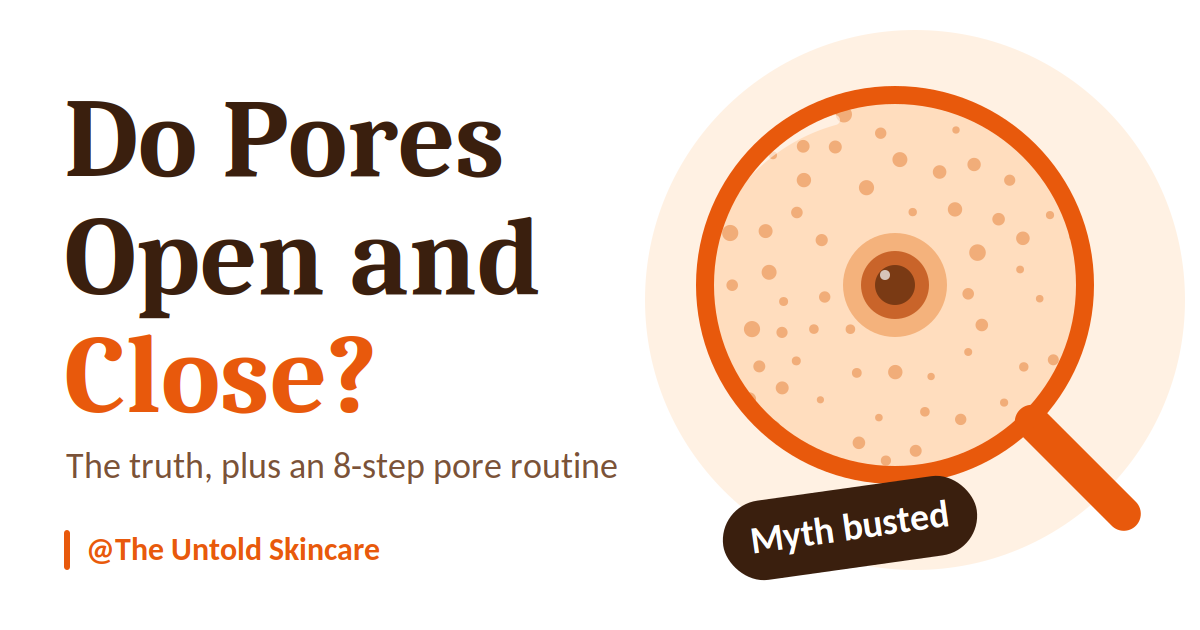
The Short Answer: No, pores don’t open and close.
Pores are tiny openings in the skin where hair follicles reach the surface. They have no muscles, so they can’t open or close. Steam, heat, and cold water can change how your skin feels and looks for a few minutes, but they don’t change your pore size. What really changes how pores look is oil, clogging, age, sun damage, and genetics.
That’s the answer in a nutshell. Now let’s understand why, because once you know how pores work, choosing the right skincare gets much easier.
What Really Are Pores?
Think of a pore as a tiny funnel in your skin. Under the surface, each hair follicle has a small oil gland attached to it, called a sebaceous gland. This gland makes sebum, the natural oil that keeps your skin soft and protected. The sebum travels up the follicle and out through the pore onto your skin.

A few facts that put this in perspective:
Almost your whole body has these glands. Oil glands are found everywhere except the palms of your hands and soles of your feet.
Your face has the most. The forehead, nose, and cheeks have some of the highest concentrations, often cited at several hundred glands per square centimeter, compared with around 100 on much of the body. That’s why your T-zone (forehead, nose, chin) gets shiny first.
There are two kinds of “pores.” Oil pores (hair follicle openings) are the ones you see on your nose and cheeks. Sweat pores are separate. Your body has roughly 2 to 4 million sweat glands, but their openings are far too small to see. When people worry about face pores, they’re almost always talking about oil pores.
Sebum is not the enemy. It helps hold moisture in and protects against germs. The goal of pore care is never “no oil.” It’s balanced oil and clear pores.
Since your pore is just a hole that a hair and some oil pass through, there’s nothing in it that can flex, squeeze, or seal itself.
Why The Pores Open and Close Myth Won’t Go Away
If pores can’t move, why does everyone swear that steam and cold water work? Because the myth is built on things that are real, just misunderstood.
1. Heat softens oil and makes skin feel different. When your skin gets warm, your blood vessels widen and the sebum inside your pores gets softer and runnier. An older, often-cited study found that oil production goes up by roughly 10% for every 1°C rise in skin temperature. Because the oil is softer, blackheads and buildup come out more easily, and that feels like your pores “opened.” In reality, the plug loosened. The pore didn’t change size.
2. Cold makes skin tighten temporarily. Cold water and ice make your blood vessels narrow and your skin feel firmer and less puffy. For a few minutes, skin can look smoother and pores can look a bit less noticeable. But this effect fades quickly, and the pore is exactly the same size as before.
3. Goosebumps confuse things. When you’re cold, tiny muscles attached to your hair follicles pull each hair upright, which creates goosebumps. It’s easy to think those muscles are closing pores. But those muscles work on the hair, not on the pore opening. They don’t seal anything.
4. Products sell the idea. “Pore-tightening” toners and “pore-closing” masks often contain alcohol or astringent ingredients. These can cause mild irritation and slight swelling, which makes the skin look tighter for a short time. It’s a temporary illusion, not a change in pore structure.
5. It sounds simple. “Open with heat, close with cold” is easy to remember, and easy myths spread fast.
What Really Decides How Big Your Pores Look
Pore size isn’t random. Here are the real factors, from the ones you can’t change to the ones you can.
1. Genetics. Your family plays the biggest role. If your parents have visible pores, you’re more likely to as well. You can’t change your genes, but you can change how pores look.
2. Oil production. More sebum means larger-looking pores. Oil is driven by hormones called androgens, which is why pores often look bigger during puberty, around periods, and in stressful times. On average, men tend to produce more oil and have larger pores than women.
3. Clogged pores. When oil, dead skin cells, and sometimes makeup or sunscreen build up inside a pore, the plug stretches the opening. This is what a blackhead is. The dark color isn’t dirt. It’s oil and skin cells that darken after contact with air. Clogged pores left alone can stay stretched and look bigger.
4. Age and collagen loss. Collagen is the protein that keeps skin firm and springy. It’s often estimated that we lose roughly 1% of our collagen each year as we get older. When the skin around a pore loses support, the pore can look wider and more droopy. Studies using skin imaging have found that visible pore size tends to increase with age. Skin also renews itself more slowly over time. It takes about 28 days in young adults, but it can take much longer in older adults, so dead cells linger and clog pores more easily.
5. Sun damage. The Skin Cancer Foundation says up to 90% of the visible changes we blame on aging come from sun exposure. UV rays break down collagen and elastin, the same support system that keeps pores looking small.
6. Where the pore is. Pores on your nose and forehead are naturally bigger because those areas have bigger oil glands.
7. Habits. Squeezing blackheads, scrubbing hard, and skipping sunscreen can all make pores look worse over time.
The good news: numbers 2, 3, 4, 5, and 7 are things you can influence.
Related Post: How to Reduce Sebum Production? A Comprehensive Guide
Pore Myths Vs. Facts
| Myth | Truth |
| Steam opens pores | Steam softens oil, but pores don’t change size. It can also irritate sensitive skin. |
| Cold water closes pores | It tightens skin for a few minutes. Pore size stays the same. |
| You can shrink pores permanently | You can’t, but you can make them look smaller by keeping them clean and supporting the skin around them. |
| Pore strips fix large pores | They lift the top of blackheads, but the pore refills quickly. Overuse can irritate. |
| Toners “close” pores | They give a short-term tight feeling, often from irritation. |
| Dirt causes blackheads | The color comes from oxidized oil and skin cells, not dirt. |
| Oily skin doesn’t need moisturizer | It does. Skipping it can make skin produce more oil. |
| Bigger pores mean unhealthy skin | Not at all. Pores are normal and healthy. |
7 Mistakes That Make Pores Look Larger
Mistake 1: Squeezing and picking. Squeezing can push oil and bacteria deeper, cause swelling, and leave marks or scars. Repeated squeezing can stretch the pore and make it more noticeable.
Mistake 2: Skipping sunscreen. Sun damage breaks down collagen around pores. This is the biggest long-term pore mistake, and the easiest one to fix.
Mistake 3: Scrubbing hard. Gritty scrubs and rough cloths damage your skin barrier and can trigger more oil. Your skin needs gentle care, not friction.
Mistake 4: Going to bed with makeup or sunscreen on. These mix with oil overnight and can clog pores. Cleanse every night.
Mistake 5: Skipping moisturizer. When skin feels dry, it can make even more oil to make up for it. Light hydration helps balance things.
Mistake 6: Using pore strips all the time. Occasional use is okay for some people, but frequent use can irritate skin and strip protective oil.
Mistake 7: Relying on alcohol-heavy toners and long, hot steaming. Both can dry and inflame skin. People with rosacea or sensitive skin especially should be careful with steam.
Also Read: How to Get Clear Skin? 20 Tips That Include Everything
The Best Skincare Routine for Pores: 8 Step Process
Now for what actually works. This skincare routine for pores focuses on three goals: keep pores clear, control oil gently, and protect the skin’s support system. It takes about 5 to 10 minutes.
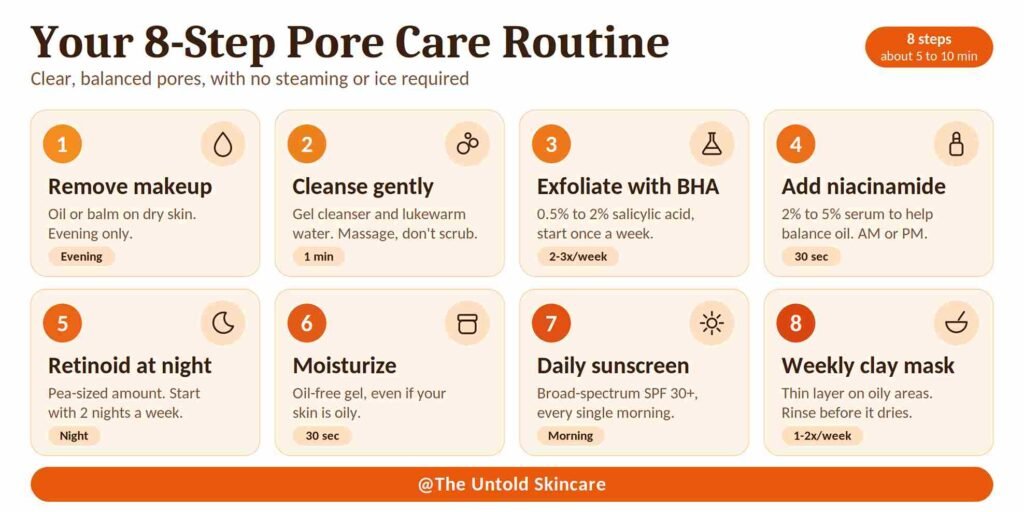
1. Remove Makeup and Sunscreen (Evening)
Sunscreen and makeup are designed to stay on all day. Water alone won’t remove them, and leftovers can clog pores overnight.
How to do it:
- Use a cleansing oil, balm, or micellar water.
- Apply to dry skin with dry hands.
- Massage gently for 30 to 60 seconds, focusing on the nose, chin, and hairline.
- Add a little water so it turns milky, then rinse with lukewarm water.
- Tip: If you wear no makeup or sunscreen, you can skip this step.
2. Cleanse Gently

A regular cleanser clears sweat, extra oil, and leftover product.
How to do it:
- Wet your face with lukewarm water.
- Use a coin-sized amount of gel or foaming cleanser.
- Massage in small circles for 30 to 60 seconds. Spend extra time on your nose and chin.
- Rinse well and pat dry with a clean towel. Don’t rub.
What to look for: “Non-comedogenic” (won’t clog pores), “fragrance-free,” and “pH-balanced.”
What to avoid: Harsh scrubs, hot water, and cleansing more than twice a day (unless you’ve been sweating).
3. Exfoliate Smartly with a BHA (1-2 times a week)

This is the most powerful step for clogged pores. Salicylic acid (BHA) is oil-soluble, which means it can travel into pores and dissolve the mix of oil and dead cells inside. Over-the-counter products usually contain 0.5% to 2%.
How to do it:
- Use it after cleansing, on dry skin.
- Apply a thin layer to the areas with clogged pores, like your nose, chin, and forehead.
- Start with 1 night a week and slowly build to 2 or 3 nights.
- Follow with moisturizer.
Watch out: Don’t use it on the same night as a retinoid at first. Stop or reduce if your skin feels stingy, tight, or peeling.
Also Read: 11 Proven Ways to Repair Skin Barrier
4. Add Niacinamide (Morning or Night)

Niacinamide (vitamin B3) is one of the best-studied ingredients for oily skin. A 2006 study in the Journal of Cosmetic and Laser Therapy found that a 2% niacinamide product reduced oil production within a few weeks. Other research using 2% to 5% shows it can support the skin barrier and improve skin texture, which helps pores look more refined.
How to do it:
- Choose a serum with 2% to 5%. Higher isn’t always better and can irritate.
- Use 2 to 3 drops on clean skin.
- Press it in gently and wait about 30 seconds.
Tip: It’s gentle enough for most people and works well with most other ingredients.
5. Use a Retinoid at Night
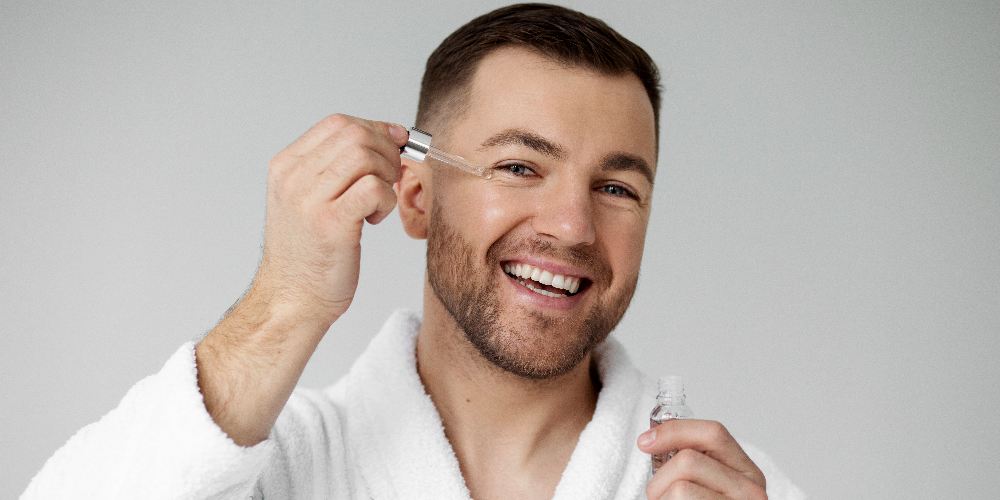
Retinoids (like retinol, retinaldehyde, or prescription tretinoin) speed up skin renewal and support collagen. That helps clear clogged pores and firm the skin around them. Results take time. Most clinical studies run 8 to 12 weeks before showing clear changes.
How to do it:
- Use a pea-sized amount for the whole face.
- Apply to dry skin at night, after cleansing.
- Start with 2 nights per week and slowly move up.
- Follow with moisturizer. Some people “sandwich” retinol between two layers of moisturizer to reduce irritation.
Important: Retinoids can make skin more sun-sensitive, so always wear sunscreen the next day. They’re not recommended during pregnancy. Ask your doctor if you’re pregnant or planning to be.
6. Moisturize (Even if You’re Oily)
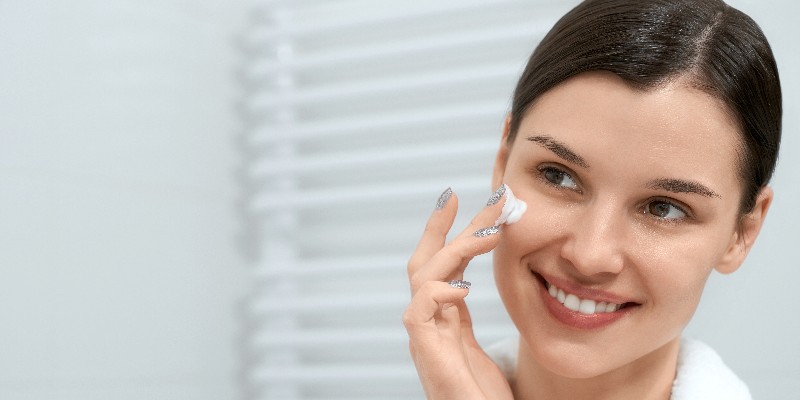
A good moisturizer keeps your skin barrier healthy and prevents dryness that can cause extra oil.
How to do it:
- Use a dime-sized amount for the face.
- Apply on slightly damp skin.
- Press it in with your palms.
Choosing the right one:
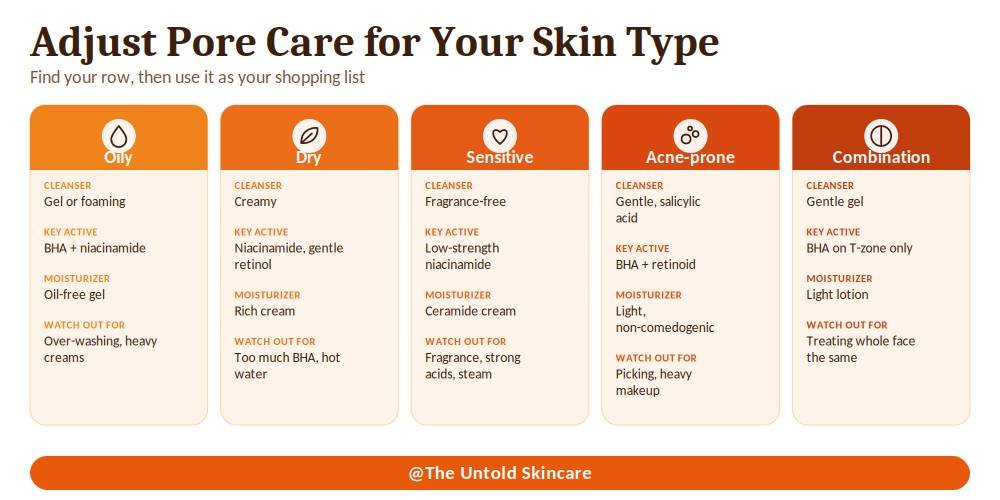
- Oily or acne-prone: Oil-free gel or gel-cream, “non-comedogenic.”
- Dry: Cream with ceramides or glycerin.
- Sensitive: Fragrance-free with ceramides.
Related Post: 5 Best Moisturizers for Oily Skin
7. Apply Sunscreen Every Morning

This is the most important step for keeping pores from looking bigger with age. It protects the collagen that supports your skin.
How to do it:
- Choose a broad-spectrum SPF 30 or higher, as recommended by the American Academy of Dermatology.
- Use about a quarter teaspoon for the face, and a bit more for the neck.
- Apply as the last step of your morning routine.
- Reapply every 2 hours if you’re outside.
For pore-prone skin: Pick a lightweight gel, fluid, or “oil-free” sunscreen labeled non-comedogenic.
Related Post: 7 Best Sunscreens for Oily Acne-Prone Skin
8. Add a Weekly Clay Mask

Clay masks (kaolin or bentonite) absorb extra oil and give skin a smoother feel.
How to do it:
- Use once or twice a week on clean skin.
- Apply a thin layer on oily areas only.
- Leave on for 5 to 10 minutes, and rinse off before it fully dries and cracks.
- Follow with moisturizer.
Watch out: Overusing masks can dry your skin and cause more oil later.
What to Expect and When
Skincare takes patience. Here’s a realistic timeline:
Week 1 to 2: Skin feels cleaner and less greasy. You may see fewer blackheads.
Week 4: Oil is better balanced, and texture looks smoother.
Week 8 to 12: Pores can look visibly smaller and skin feels firmer, especially with retinoid and daily sunscreen.
Long term: Consistency and sun protection give the best payoff.
A few first-week bumps or dry patches can happen when starting a retinoid or acid. If you get significant burning or peeling, take a break for a week and restart slowly.
Professional Treatment for Large Pores
If home care isn’t enough, a dermatologist can help with:
Prescription retinoids such as tretinoin, which are stronger than store-bought versions.
Chemical peels that remove dead skin and clear pores.
Microneedling, which encourages collagen production.
Laser and light treatments that can tighten skin and improve texture.
Professional extractions that safely clear blackheads (much safer than DIY squeezing).
Results vary, and some treatments need several sessions. Ask about downtime, side effects, and costs. These are also usually not recommended if you have active skin infections or certain skin conditions.
Frequently Asked Questions
1. Do pores open and close?
No. Pores don’t have muscles, so they can’t open or close. Heat and cold change how skin feels and looks briefly, but not pore size.
2. Does steam open pores?
Steam softens oil and can loosen plugs, but it doesn’t make pores bigger or smaller. It can also irritate sensitive skin.
3. Does cold water close pores?
No. It can tighten skin temporarily and reduce puffiness, but pore size stays the same.
4. Can you shrink pores permanently?
Not really. Pore size is mostly set by genetics. But you can make pores look smaller by keeping them clear, controlling oil, and protecting collagen.
5. Why are the pores on my nose so big?
Your nose has some of the largest oil glands on your face, so pores there are naturally more noticeable.
6. Do pore strips work?
They remove the top of a blackhead for a short time, but the pore refills. Frequent use can irritate skin.
7. Does niacinamide shrink pores?
It doesn’t shrink them, but studies show it can lower oil production and improve skin texture, which helps pores look less obvious.
8. Do pores get bigger with age?
They can look bigger as collagen decreases and skin loses firmness, especially with lots of sun exposure.
9. Does makeup clog pores?
Some can, especially heavy or oil-based formulas. Look for “non-comedogenic” labels, and always remove makeup at night.
10. Are large pores a sign of unhealthy skin?
No. Pores are a normal, healthy part of skin.
References:
Facial Skin Pores: a Multiethnic Study
The Truth About Pore Size: What Science Actually Says
Analysis of the skin surface and inner structure around pores on the face